Rave slang is the informal language that grows around electronic music, dance floors, festivals, DJs, clubs, and late-night party communities. Like slang in any subculture, these expressions help people communicate quickly while also creating a feeling of belonging.
A single word can describe the music, atmosphere, crowd, dancing, or overall energy without needing a long explanation.
Rave vocabulary has changed considerably over the years. Some expressions came from early underground dance scenes, while others spread through social media, festival culture, and Gen Z conversations.
Terms that once belonged mainly to club regulars can now appear in TikTok captions, group chats, memes, and everyday conversations.
Understanding rave slang is useful whether you’re attending a festival, discussing electronic music online, or simply trying to understand what someone means when they describe a night out. However, slang works best when it feels natural.
Knowing the meaning is only half the skill; tone, timing, audience, and context matter just as much.
Quick Reference Table
| Slang Term | Meaning | Tone | Age Group | Online/Offline Usage |
|---|---|---|---|---|
| Raver | Someone who regularly attends raves | Casual | Gen Z & Millennials | Both |
| PLUR | Peace, Love, Unity, Respect | Positive | Millennials & Gen Z | Both |
| Kandi | Colorful friendship bracelets exchanged at raves | Friendly | Gen Z & Millennials | Both |
| Headliner | Main or featured performer | Casual | All ages | Both |
| Set | A DJ’s performance | Music-focused | All ages | Both |
| Drop | A powerful transition or peak in electronic music | Excited | All ages | Both |
| Vibe | The overall mood or atmosphere | Casual | Gen Z & Millennials | Both |
| Banger | An especially energetic or impressive track | Enthusiastic | Gen Z | Both |
| Dancefloor | The area where people dance | Casual | All ages | Both |
| Festival season | Period when major music festivals take place | Casual | Gen Z & Millennials | Both |
| Afterparty | A gathering that continues after the main event | Informal | Gen Z & Millennials | Both |
11 Rave Slang Terms
Raver
- Meaning: A raver is someone who participates in rave culture, particularly by attending electronic-music events, underground parties, clubs, or festivals. The word can describe a dedicated scene regular or simply someone who loves the experience.
- When to Use It: Use it when talking casually about someone’s connection to rave or electronic-music culture.
- When NOT to Use It: Avoid labeling someone a raver simply because they attended one EDM show if they don’t identify with the term.
- Example in Conversation:
- “Are you going to the warehouse show Friday?”
- “Definitely. You know I’m a raver.”
- Is It Still Trending? Yes
PLUR
- Meaning: PLUR stands for Peace, Love, Unity, Respect. It represents an ideal associated with rave culture: treating other people kindly, looking after the community, and creating a welcoming atmosphere.
- When to Use It: It works well when discussing rave culture, community values, or the positive side of festival etiquette.
- When NOT to Use It: Don’t throw “PLUR” into unrelated conversations just to sound knowledgeable about rave culture.
- Example in Conversation:
- “Someone helped me find my friends after I got separated.”
- “That’s the PLUR spirit.”
- Is It Still Trending? Yes
Kandi
- Meaning: Kandi refers to colorful, often handmade bead bracelets exchanged between people at raves and festivals. Swapping them can be a small gesture of friendship, connection, or appreciation.
- When to Use It: Mention it when discussing festival traditions, accessories, or exchanges between ravers.
- When NOT to Use It: Don’t assume every bracelet at a festival is kandi; ordinary jewelry doesn’t automatically carry the same cultural meaning.
- Example in Conversation:
- “Did you make those bracelets yourself?”
- “Yeah, I’m bringing extra kandi to trade tonight.”
- Is It Still Trending? Yes
Headliner
- Meaning: The headliner is the major act receiving the most prominent billing at an event. At a large festival, the headliner is often the performer people specifically bought tickets to see.
- When to Use It: Use it when discussing festival lineups, event schedules, or the biggest artist on a bill.
- When NOT to Use It: Don’t call every DJ performing at an event the headliner.
- Example in Conversation:
- “Who’s playing last?”
- “The headliner closes the main stage.”
- Is It Still Trending? Yes
Set
- Meaning: In rave conversations, a set is a DJ’s performance during a particular time slot. Fans might remember a set because of its song selection, transitions, atmosphere, or unexpected moments.
- When to Use It: Talk about a DJ’s performance as a whole rather than referring to just one track.
- When NOT to Use It: Don’t use “set” when you mean a single song.
- Example in Conversation:
- “How was the closing performance?”
- “That set was incredible from beginning to end.”
- Is It Still Trending? Yes
Drop
- Meaning: A drop is the point in an electronic track where the energy suddenly rises or the main rhythmic section hits after a buildup. At a rave, it can be the moment when the crowd reacts most strongly.
- When to Use It: Use it when talking about memorable moments in electronic tracks or live performances.
- When NOT to Use It: Don’t treat every beat change as a major drop.
- Example in Conversation:
- “Did you hear that new track?”
- “Yeah, the drop caught me completely off guard.”
- Is It Still Trending? Yes
Vibe
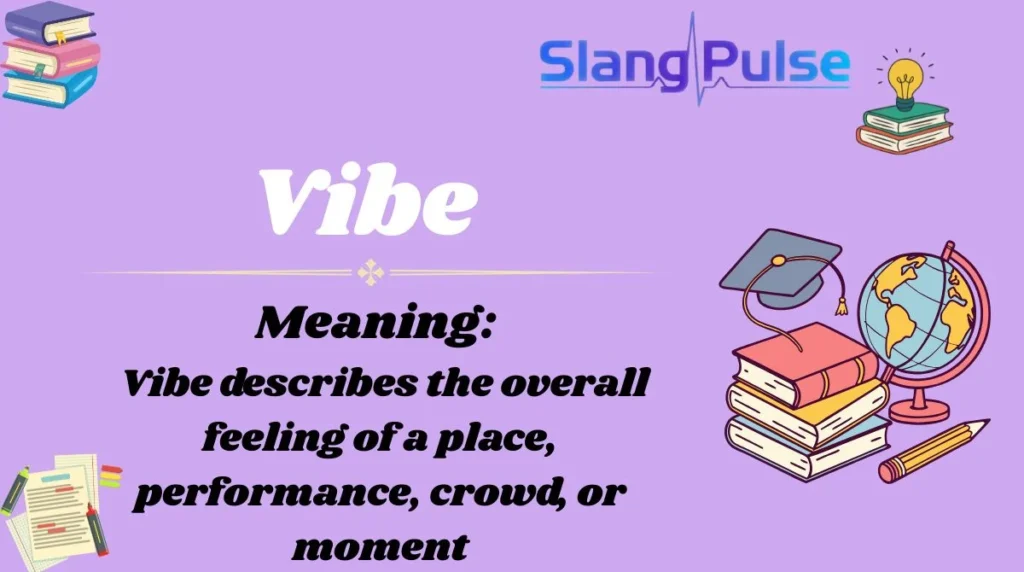
- Meaning: Vibe describes the overall feeling of a place, performance, crowd, or moment. At a rave, someone might talk about the vibe to describe everything from the music and lighting to the crowd’s energy.
- When to Use It: It’s useful when you want to describe an atmosphere without getting overly specific.
- When NOT to Use It: Avoid using “vibe” repeatedly for every part of an event; it can become vague.
- Example in Conversation:
- “Should we stay at this stage?”
- “Absolutely. The vibe here is unreal.”
- Is It Still Trending? Yes
Banger
- Meaning: A banger is a track that hits especially hard or creates a strong reaction. In rave culture, it’s usually reserved for music that feels energetic, exciting, or particularly effective on a dance floor.
- When to Use It: Use it when enthusiastically praising a song.
- When NOT to Use It: Calling every song a banger weakens the expression.
- Example in Conversation:
- “What did you think of the DJ’s new track?”
- “That was a straight-up banger.”
- Is It Still Trending? Yes
Dancefloor
- Meaning: The dancefloor is more than simply the physical area where people dance. In rave conversations, it can refer to the heart of the event—the place where music, movement, and crowd energy come together.
- When to Use It: Use it naturally when talking about dancing or crowd movement.
- When NOT to Use It: Don’t use it as though it automatically means the entire venue.
- Example in Conversation:
- “Where did everyone disappear to?”
- “They’re all on the dancefloor.”
- Is It Still Trending? Yes
Festival Season
- Meaning: Festival season refers to the stretch of the year when outdoor music festivals and large-scale events become especially common. For electronic-music fans, it can feel like a recurring annual chapter filled with travel, lineups, outfits, and weekend events.
- When to Use It: Use it when discussing upcoming festivals or planning multiple events.
- When NOT to Use It: Don’t assume every music event belongs to festival season.
- Example in Conversation:
- “Why are you saving so much vacation time?”
- “Festival season is coming. I have plans.”
- Is It Still Trending? Yes
Afterparty
- Meaning: An afterparty is an informal gathering that happens after the main concert, rave, or festival event ends. It may take place at another venue, a private location, or an officially organized secondary event.
- When to Use It: Use it when discussing plans that continue after the primary event.
- When NOT to Use It: Don’t call a regular post-concert dinner an afterparty unless the setting actually has that kind of social atmosphere.
- Example in Conversation:
- “Is everyone heading home after the festival?”
- “Not yet. There’s an afterparty nearby.”
- Is It Still Trending? Yes
Generational Slang Comparison
Gen Z Usage
Gen Z often blends traditional rave terminology with broader internet slang. Words such as vibe, banger, and set can move effortlessly between festival conversations, social media posts, and group chats. Online culture also makes rave vocabulary spread faster than it did in earlier decades.
Millennials
Millennials are more likely to recognize long-established rave terms such as raver, PLUR, kandi, and afterparty. Their familiarity often comes from club culture, festival communities, blogs, forums, and the growth of EDM during the 2000s and 2010s.
Older Slang Differences
Older rave communities may use expressions connected more strongly to underground scenes and earlier dance-music culture. Some terms remain recognizable today, but their frequency and meaning can shift as new generations enter the scene.
How to Use Rave Slang Naturally Without Sounding Awkward
Match Your Tone
A casual conversation about a DJ set is a natural place for words like banger, drop, or vibe. A serious conversation about event safety probably isn’t.
Pay Attention to Context
Slang is strongest when it communicates something specific. Saying “that drop was wild” tells someone exactly what impressed you. Randomly inserting several slang terms into one sentence can sound forced.
Consider the Social Setting
The same expression can feel normal among festival friends and strange in a workplace conversation. Know who you’re speaking to before switching heavily into rave vocabulary.
Common Slang Mistakes
Using Outdated Slang
Some expressions become less common over time. Using old rave terminology without understanding its history can make your language sound performative rather than natural.
Using Slang in Formal Writing
Rave slang generally belongs in casual communication. Academic papers, professional emails, applications, and formal reports usually require clearer standard language.
Overusing Slang
You don’t need five slang terms in every sentence. A single well-placed expression often sounds much more natural than trying to demonstrate everything you know.
Practice Section
Fill in the Blanks
- The DJ’s performance was called a ______.
- The crowd went control when the ______ hit.
- A person deeply involved in rave culture may be called a ______.
- Peace, Love, Unity, and Respect is shortened to ______.
- Colorful bracelets exchanged at festivals are often called ______.
- The biggest performer on a festival lineup is usually the ______.
- An energetic, impressive song can be called a ______.
- A gathering after the main event is an ______.
Choose the Correct Slang
1. Which term describes a DJ’s performance?
A. Kandi
B. Set
C. PLUR
D. Vibe
2. What does PLUR represent?
A. Peace, Love, Unity, Respect
B. Party, Lights, Unity, Rhythm
C. People, Love, Underground, Raves
D. Peace, Lyrics, Urban, Rhythm
3. Which word describes an especially energetic track?
A. Banger
B. Headliner
C. Kandi
D. Raver
4. What is the main performer at an event usually called?
A. Drop
B. Headliner
C. Vibe
D. Dancefloor
5. What is an event held after the main event called?
A. Set
B. Festival season
C. Afterparty
D. Kandi
Rewrite These Formal Sentences Into Natural Slang
- “The electronic music performance was exceptionally energetic.”
→ “That set was a total banger.” - “The atmosphere at this festival is extremely enjoyable.”
→ “The vibe at this festival is amazing.” - “We are attending another gathering after the main event.”
→ “We’re heading to the afterparty.”
FAQs
What is rave slang?
Rave slang is informal vocabulary associated with electronic music, festivals, clubs, DJs, dancefloors, and rave communities.
What does PLUR mean in rave culture?
PLUR means Peace, Love, Unity, Respect, a phrase representing positive community values within rave culture.
What does “banger” mean in EDM?
A banger is an especially energetic or exciting song that gets a strong reaction from listeners or dancers.
What is a DJ set?
A DJ set is a live performance in which a DJ plays and mixes music for an audience.
What does “raver” mean?
A raver is someone who participates in rave culture or regularly attends electronic-music events.
Is rave slang still used in 2026?
Yes. Many classic terms remain active, while newer internet and Gen Z expressions continue to influence how rave communities communicate.
Conclusion
Rave slang is more than a collection of trendy words. It reflects the history, creativity, and social identity of electronic-music communities.
Expressions such as PLUR, raver, kandi, set, drop, vibe, banger, headliner, and afterparty can make conversations more natural when they’re used in the right setting.
The key is moderation. You don’t need to memorize every expression or force slang into your speech. Pay attention to context, audience, tone, and cultural meaning.
Rave vocabulary changes just like the music itself, so staying aware of how different generations use these terms will help you communicate naturally rather than sounding like you’re imitating a scene.

Aira is a content writer and language enthusiast at SlangPulse, specializing in internet slang, social media trends, and modern digital communication