Irish slang is one of the most distinctive parts of everyday speech in Ireland. It can make a conversation sound friendly, humorous, casual, or unmistakably local.
Unlike formal vocabulary, slang often carries social meaning: the same word can change depending on the speaker, region, age group, and situation. Expressions such as craic, grand, gas, and deadly are familiar examples, but Irish speech has many more colorful phrases.
People use slang because it creates a sense of belonging and familiarity. Friends may use it to joke around, while family members can use certain expressions almost automatically. Irish slang also changes constantly.
Some phrases have deep roots in older Irish and Hiberno-English, while newer expressions spread through social media, music, television, gaming, and younger communities.
In modern communication, Irish slang appears both offline and online. You might hear it in a pub, classroom, workplace, or football crowd and then see the same phrase in a text or social-media comment. Understanding the context is therefore just as important as knowing the literal meaning.
Quick Reference Table
| Slang Term | Meaning | Tone | Age Group | Online/Offline Usage |
|---|---|---|---|---|
| Craic | Fun, entertainment, or news | Friendly | All ages | Both |
| Grand | Fine, okay, satisfactory | Casual | All ages | Both |
| Gas | Funny or entertaining | Playful | Mostly younger/middle-aged | Both |
| Deadly | Excellent, great | Positive | All ages | Both |
| Eejit | Foolish person | Teasing | All ages | Mostly offline |
| Gobshite | Foolish or annoying person | Strong/insulting | All ages | Both |
| Acting the maggot | Behaving foolishly | Playful | All ages | Mostly offline |
| Give out | Scold or complain | Casual | All ages | Both |
| Yoke | Thing or object | Casual | All ages | Both |
| Your man | That guy/person | Informal | All ages | Both |
| Your one | That woman/person | Informal | All ages | Both |
| Fair play | Well done / respect | Supportive | All ages | Both |
| Thanks a million | Thank you very much | Warm | All ages | Both |
| Lashing | Heavy rain | Casual | All ages | Both |
| Knackered | Very tired | Casual | All ages | Both |
| Banjaxed | Broken or exhausted | Humorous | All ages | Both |
| Kip | Sleep or a place to sleep | Casual | All ages | Both |
| Scarper | Leave quickly | Informal | Older/mixed | Both |
| Culchie | Person from a rural area | Context-dependent | All ages | Both |
| The jacks | Toilet | Casual | All ages | Mostly offline |
20 Irish Slang Terms
Craic
- Meaning: Craic is one of the best-known Irish expressions. Depending on the sentence, it can mean fun, good times, entertainment, or interesting news. “What’s the craic?” can simply mean “What’s happening?” or “How are things?”
- When to Use It: Use it with friends or in relaxed social conversation.
- When NOT to Use It: Avoid forcing it into formal business communication or using it repeatedly just to sound Irish.
- Example in Conversation:
“What’s the craic tonight?”
“We’re heading into town after work.” - Is It Still Trending? Yes
Grand
- Meaning: Grand usually means fine, okay, satisfactory, or no problem. If someone says, “That’s grand,” they may genuinely be pleased, or they may simply mean that something is acceptable.
- When to Use It: It works naturally in everyday conversations, texts, and casual arrangements.
- When NOT to Use It: Don’t assume “grand” always means someone is extremely enthusiastic. Context and tone matter.
- Example in Conversation:
“Can I call you later?”
“Yeah, grand.” - Is It Still Trending? Yes
Gas
- Meaning: In Irish conversation, gas often describes someone or something that is very funny, entertaining, or amusing. Calling a person “gas” can mean they are great fun to be around.
- When to Use It: Use it when describing a funny story, person, event, or situation.
- When NOT to Use It: Don’t interpret it as referring to fuel unless the context clearly indicates that meaning.
- Example in Conversation:
“Did you hear what he said?”
“He’s absolutely gas.” - Is It Still Trending? Yes
Deadly
- Meaning: Deadly sounds negative in standard English, but Irish speakers can use it positively to mean excellent, brilliant, or really good. A “deadly” concert, plan, or meal is something worth praising.
- When to Use It: Best suited to relaxed conversations with people familiar with Irish English.
- When NOT to Use It: Avoid it where the literal meaning of “deadly” could cause confusion.
- Example in Conversation:
“How was the match?”
“Deadly. We won in the last minute.” - Is It Still Trending? Yes
Eejit
- Meaning: Eejit is a playful Irish form of “idiot.” It can be genuinely insulting, but among friends and relatives it is often affectionate teasing rather than serious abuse.
- When to Use It: Use it jokingly with people who understand your relationship and tone.
- When NOT to Use It: Don’t call strangers, customers, teachers, or colleagues an eejit unless you know the relationship is informal enough.
- Example in Conversation:
“You left your keys in the door again.”
“I know, I’m some eejit.” - Is It Still Trending? Yes
Gobshite
- Meaning: Gobshite is a much stronger expression for someone considered foolish, irritating, or foolish. It can also describe someone who talks nonsense.
- When to Use It: Mostly among friends or in humorous, informal situations.
- When NOT to Use It: Avoid it in professional situations and around people who may take insults seriously.
- Example in Conversation:
“Who broke the chair?”
“That gobshite who was messing around.” - Is It Still Trending? Yes
Acting the Maggot
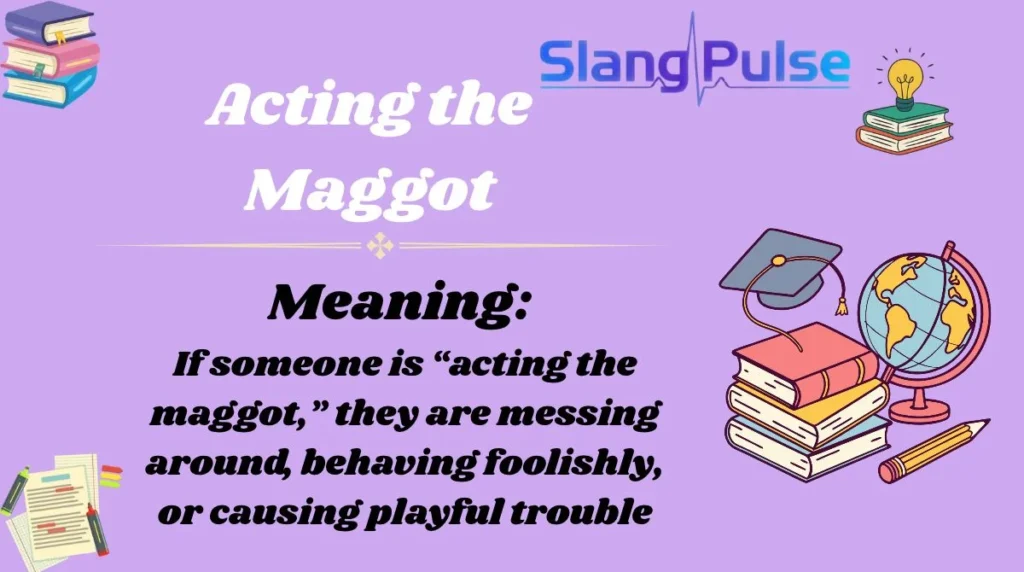
- Meaning: If someone is “acting the maggot,” they are messing around, behaving foolishly, or causing playful trouble. It often describes someone who should settle down but keeps joking.
- When to Use It: Great for teasing friends, siblings, or children who are being silly.
- When NOT to Use It: Don’t use it when serious misconduct requires a clear and professional description.
- Example in Conversation:
“Will you stop acting the maggot?”
“Alright, alright—I’m finished.” - Is It Still Trending? Yes
Give Out
- Meaning: In Irish English, to “give out” can mean to scold someone or complain about something. It is a classic example of Irish usage that may sound unusual elsewhere.
- When to Use It: Use it when talking casually about someone complaining or telling another person off.
- When NOT to Use It: In formal writing, use clearer alternatives such as “criticize,” “complain,” or “scold.”
- Example in Conversation:
“Mam was giving out to me this morning.”
“What did you do?” - Is It Still Trending? Yes
Yoke
- Meaning: Yoke is an extremely useful informal word for an object or thing whose exact name you don’t know, can’t remember, or simply don’t want to specify.
- When to Use It: Use it casually when pointing out an everyday object.
- When NOT to Use It: Don’t replace precise terminology with “yoke” when explaining something technical or important.
- Example in Conversation:
“Can you pass me that yoke?”
“The charger?” - Is It Still Trending? Yes
Your Man
- Meaning: “Your man” can refer to a particular man or guy, even when he isn’t literally the listener’s relative or acquaintance. Context usually makes it clear who is being discussed.
- When to Use It: Use it naturally when chatting about someone whose identity is already obvious from the conversation.
- When NOT to Use It: Avoid it when speaking to someone unfamiliar with Irish conversational habits.
- Example in Conversation:
“Your man from the shop was asking for you.”
“Oh, the guy with the glasses?” - Is It Still Trending? Yes
Your One
- Meaning: “Your one” works similarly to “your man” but generally refers to a woman or girl being discussed. It is informal and highly dependent on context.
- When to Use It: Casual conversations where everyone understands which person you mean.
- When NOT to Use It: Avoid it when introducing someone formally or when precise identification matters.
- Example in Conversation:
“Your one from the office called.”
“Which one?” - Is It Still Trending? Yes
Fair Play
- Meaning: Fair play is a way of showing approval, respect, or congratulations. It can acknowledge someone’s effort, honesty, achievement, or good decision.
- When to Use It: Use it after someone accomplishes something or handles a situation well.
- When NOT to Use It: Don’t force it into every compliment; it sounds most natural when the situation genuinely calls for recognition.
- Example in Conversation:
“I finished the whole project before Friday.”
“Fair play to you.” - Is It Still Trending? Yes
Thanks a Million
- Meaning: This warm expression simply means thank you very much. It adds friendliness and appreciation without necessarily sounding overly formal.
- When to Use It: Use it after someone helps you, gives you something, or does you a favor.
- When NOT to Use It: It isn’t ideal for highly formal correspondence where a more conventional thank-you may be appropriate.
- Example in Conversation:
“I printed those documents for you.”
“Thanks a million!” - Is It Still Trending? Yes
Lashing
- Meaning: A lashing can describe a large amount or a heavy spell, particularly when talking about rain. “There’s a lashing outside” suggests the weather is seriously wet.
- When to Use It: Use it casually when discussing heavy rain or, depending on context, a large quantity.
- When NOT to Use It: Don’t assume every English speaker will understand the Irish sense immediately.
- Example in Conversation:
“Are you walking home?”
“Not in this lashing of rain.” - Is It Still Trending? Yes
Knackered
- Meaning: Knackered means extremely tired or exhausted. It is useful after a long day, a difficult journey, or a demanding activity.
- When to Use It: Perfect for casual conversations about feeling worn out.
- When NOT to Use It: Avoid it in formal reports or professional documents.
- Example in Conversation:
“Want to go out tonight?”
“No chance—I’m knackered.” - Is It Still Trending? Yes
Banjaxed
- Meaning: Banjaxed is a wonderfully flexible Irish expression. Something can be banjaxed when it is broken, ruined, damaged, or no longer working properly. It can also describe a person who is completely worn out.
- When to Use It: Use it informally for broken objects or extreme tiredness.
- When NOT to Use It: Don’t use it where a precise technical description is required.
- Example in Conversation:
“Is the old laptop working?”
“No, it’s completely banjaxed.” - Is It Still Trending? Yes
Kip
- Meaning: Kip can mean sleep, a nap, or a place where someone sleeps. “I need a kip” normally means the speaker wants some rest.
- When to Use It: Use it in casual conversations about sleeping or resting.
- When NOT to Use It: Avoid it in formal writing where “sleep” or “rest” is clearer.
- Example in Conversation:
“You look exhausted.”
“I’m going for a quick kip.” - Is It Still Trending? Yes
Scarper
- Meaning: To scarper means to leave or get away quickly. It has an informal, slightly cheeky feel and can sound humorous depending on the situation.
- When to Use It: Use it when joking about leaving somewhere quickly.
- When NOT to Use It: It is less suitable for formal instructions or serious emergency communication.
- Example in Conversation:
“The rain’s starting again.”
“Right, we’d better scarper.” - Is It Still Trending? Declining
Culchie
- Meaning: Culchie is a colloquial term associated with someone from a rural area, particularly outside a city. Depending on the speaker and situation, it can be affectionate, neutral, or mildly derogatory.
- When to Use It: Use it carefully among people who understand the regional and social context.
- When NOT to Use It: Don’t use it as a casual label for strangers because some people may regard it as dismissive.
- Example in Conversation:
“He moved to Dublin from the country.”
“Yeah, he still calls himself a culchie.” - Is It Still Trending? Yes
The Jacks
- Meaning: “The jacks” is an informal Irish term for the toilet or bathroom. It is particularly recognizable in casual spoken Irish English.
- When to Use It: Use it with friends, family, or in relaxed social settings.
- When NOT to Use It: Choose “toilet” or “restroom” in formal or unfamiliar settings.
- Example in Conversation:
“Sorry, where are the jacks?”
“Down the hall on the left.” - Is It Still Trending? Yes
Generational Slang Comparison
Gen Z Usage
Younger Irish speakers mix traditional Irish expressions with internet slang, abbreviations, memes, gaming language, and global social-media vocabulary. Words such as “craic,” “grand,” “gas,” and “deadly” can comfortably appear alongside newer online expressions.
Millennials
Millennials often use a blend of traditional Irish slang and modern digital language. Expressions such as “fair play,” “knackered,” “yoke,” “give out,” and “acting the maggot” remain recognizable while online communication has introduced plenty of international slang.
Older Slang Differences
Older generations may use regional expressions more naturally and may have a stronger connection to older forms of Hiberno-English. Some expressions that once sounded completely ordinary can feel humorous or old-fashioned to younger speakers, while other terms have survived across generations.
How to Use Slang Naturally Without Sounding Awkward
Match the Tone
Irish slang works best when the conversation is already relaxed. A phrase such as “fair play” can sound perfectly natural among friends but unnecessary in a formal presentation.
Pay Attention to Context
Some expressions change meaning according to tone. “Grand” might signal genuine satisfaction, simple acceptance, or even mild reluctance. Listen to how native speakers use it rather than translating every word literally.
Consider the Social Setting
A pub conversation, group chat, classroom, workplace meeting, and formal email all have different expectations. Slang should fit the relationship and environment.
Don’t Perform an Accent
Using Irish slang naturally does not require copying an Irish accent. Learn the expression, understand its meaning, and use it only when it fits the conversation.
Common Slang Mistakes
Using Outdated Slang
Not every traditional expression is equally common everywhere in Ireland. Regional differences matter, and some terms may sound dated to younger speakers.
Using Slang in Formal Writing
A university paper, business proposal, official application, or professional report generally needs standard English rather than casual slang.
Overusing Slang
Adding an Irish slang word to every sentence can make your speech sound forced. One naturally placed expression is usually more convincing than five unnecessary ones.
Ignoring Regional Differences
Irish slang isn’t completely uniform. Expressions can vary between counties, cities, rural communities, and generations.
Practice Section
Fill in the Blanks
- “What’s the ______ tonight?”
- “Don’t worry about it; it’s ______.”
- “That comedian is absolutely ______.”
- “I’m completely ______ after that long day.”
- “The old phone is totally ______.”
- “Stop ______ and finish your homework.”
- “Can you pass me that ______ over there?”
- “You played brilliantly. ______ to you!”
Choose the Correct Slang
- Which word can mean “fun” or “what’s happening”?
- A) Kip
- B) Craic
- C) Yoke
- D) Jacks
- Which expression means “well done” or “respect”?
- A) Fair play
- B) Banjaxed
- C) Scarper
- D) Knackered
- What describes someone who is extremely tired?
- A) Gas
- B) Grand
- C) Knackered
- D) Deadly
- Which term can refer to an object whose name you don’t know?
- A) Yoke
- B) Craic
- C) Culchie
- D) Eejit
- If someone is “acting the maggot,” what are they doing?
- A) Sleeping
- B) Messing around
- C) Leaving quickly
- D) Complaining
Rewrite These Sentences Using Irish Slang
- Formal: “Everything is fine, so don’t worry.”
Slang: “It’s ______, so don’t worry.” - Formal: “That person is very funny.”
Slang: “That person is absolutely ______.” - Formal: “I am extremely tired after today.”
Slang: “I’m completely ______ after today.”
FAQs
What is the most famous Irish slang word?
Craic is probably the most internationally recognized Irish slang expression.
What does “craic” mean in Irish slang?
It can mean fun, entertainment, news, or what is happening, depending on context.
What does “grand” mean in Ireland?
Grand usually means fine, okay, satisfactory, or no problem.
Is “deadly” positive Irish slang?
Yes. In casual Irish English, deadly can mean excellent or brilliant.
What does “yoke” mean in Irish slang?
A yoke is an informal word for an object or thing when its specific name isn’t given.
Do all Irish people use the same slang?
No. Irish slang varies by region, generation, community, and situation.
Conclusion
Irish slang gives everyday communication a distinctive sense of humor, warmth, informality, and local identity.
Expressions such as craic, grand, gas, deadly, fair play, yoke, knackered, and acting the maggot can make conversations feel more natural when they are used appropriately.
The key is not to memorize slang and insert it everywhere. Pay attention to tone, context, generation, and regional differences.
Some expressions are widely understood, while others can carry different meanings depending on who says them and where they are used. Used naturally, Irish slang adds character without making conversation feel forced.

Aira is a content writer and language enthusiast at SlangPulse, specializing in internet slang, social media trends, and modern digital communication